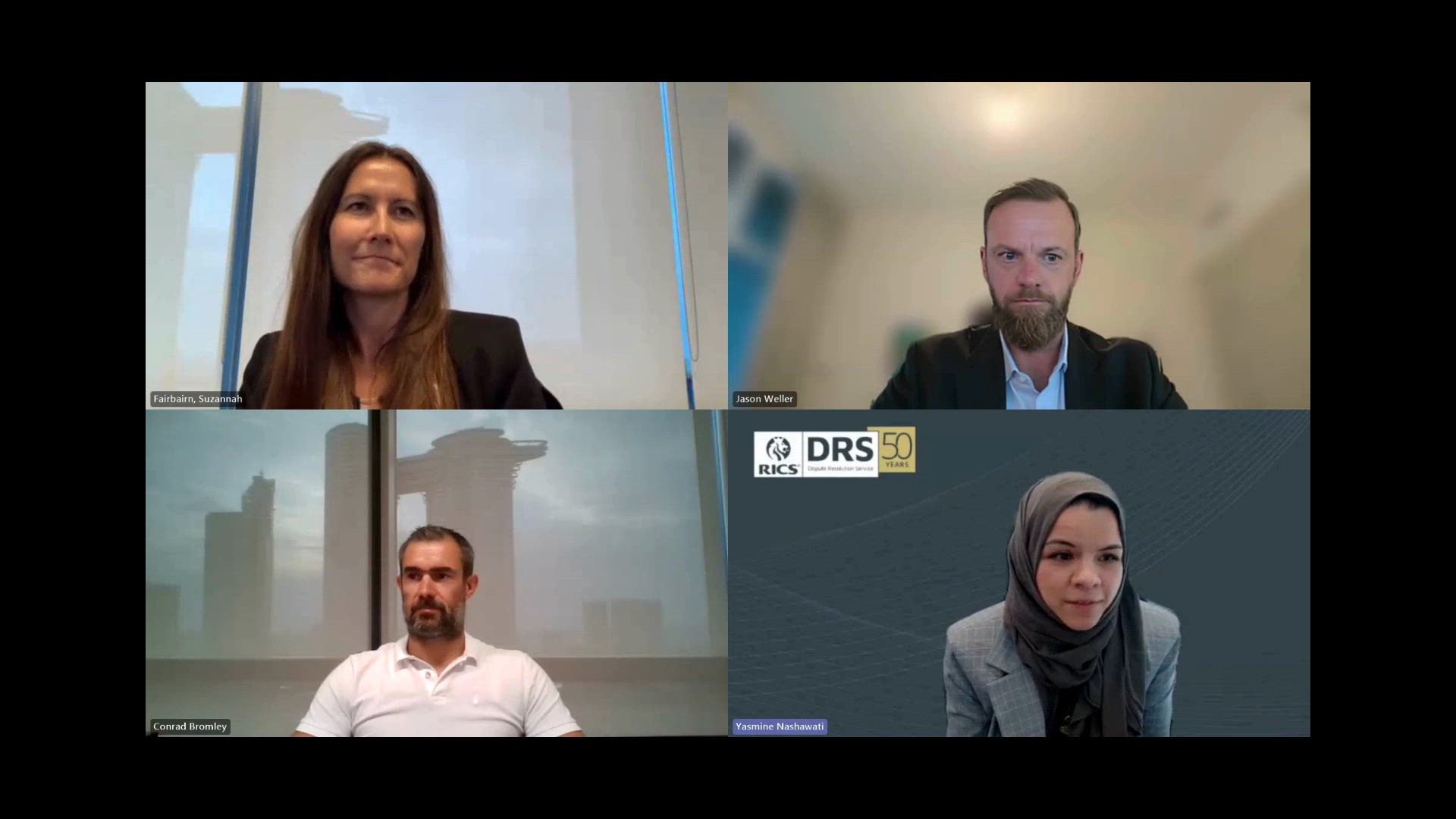
This webinar explored how construction professionals can proactively avoid disputes during periods of uncertainty and disruption, with a focus on collaboration, negotiation and early dispute resolution strategies.

The session brought together legal, commercial and dispute resolution perspectives from across the Middle East construction sector, and covered how to:

  • Prevent disputes during periods of volatility and uncertainty
  • Manage risk arising from logistics challenges, materials shortages, price fluctuation and programme delay
  • Reduce the likelihood of disputes through improved collaboration and early intervention
  • Use negotiation and mediation effectively before formal disputes escalate
     

Watch the recording below.

Post‑Webinar Q&A: Speaker Responses

Any form of alternative dispute resolution can be used earlier in the construction process. That could be a mediator, a third-party neutral evaluation, an expert determination etc. In practical terms, any process of this nature would need to be agreed between the parties, i.e., as a creature of contract. I am assuming the process is not already a tier of the dispute resolution clause in the contract.

How can it be used? I have been involved in dispute as an expert determiner and mediator, where the parties have reached an impasse on a discrete issue and need an external decision maker to help them resolve it. One example was very simply “Is this instruction from the Engineer a variation?” Both sides, as is often the case, as we discussed on the webinar, have entrenched views and are emotionally invested in their opinions. Being able to recognise this, and coming together with the other party to suggest third-party input, is the most difficult step.

A mediation does not need to be an overly formal process. Stripped back, it simply means getting a third party to help the parties agree a solution – often allowing the parties to agree a pragmatic, solution-oriented, commercial outcome that would not be possible in a formal dispute process. This can be done at any stage, and is often best undertaken before the parties are already too entrenched.

Two parts: EoT, i.e., any delay to the completion of the works because of the current regional tensions, and price escalation / inflation.

In respect of an EoT, there is no reason to deviate from your ordinary contract mechanisms. We discussed on the webinar the importance of providing timely notices in compliance with your contract and avoid – at all costs – staying silent in the hope things will resolve of their own accord. It is vital to maintain this approach; notices are intended to help both parties: to preserve the potential rights of the notifying party (contractor, subcontractor), but also make the recipient party (employer, contractor) aware of the potential problem and afford them the opportunity to take appropriate action. This is all still true in the current circumstances. We also discussed on the webinar the importance of having a clear and demonstrable record of progress / status of the Works at the time of the onset of the war. Unless you can substantiate your completion status of the works, and rate of progress in completing the works pre-war, it will be very difficult to later demonstrate the impact of the war on both measures of progress.

In respect of cost escalation, I will assume your contract does not have any provision for escalation, i.e., any cost increases during the currency of the contract are a risk born by the contractor. Many contractors are looking to Force Majeure provisions to help with the EOTs and cost increases. In terms of hardship and force majeure under UAE law, the starting point remains the contract. Many force majeure provisions will entitle a contractor to time where the event prevents performance, but not necessarily cost. However, under UAE law there are two important concepts:

  • Force majeure (impossibility): where performance becomes impossible, the obligation may be extinguished.
  • Hardship (exceptional circumstances): where performance is still possible but has become excessively onerous due to unforeseen public events, the courts or tribunals have discretion to rebalance the contract to mitigate serious loss.
     

In practice, hardship arguments are not straightforward and involve a degree of uncertainty, given the discretionary nature of relief. As such, they are often better used as part of a broader commercial negotiation strategy rather than relied on as a primary solution. This reinforces the earlier point: proactive engagement and interim commercial solutions are usually more effective than strictly legal positions in isolation.

In practical terms, and we discussed this on the webinar, there are a couple of relevant considerations. Firstly, can the parties seek to achieve a temporary arrangement to accommodate the increased costs? Essentially share the “pain” in the short term on an interim basis. This could involve taking an open-book approach to material procurement and seeking to share the additional cost burden with the employer. Whilst this might at first seem like an unattractive bargain for the employer – why would the employer pay more for something that it has no contractual requirement to? - the benefit the employer receives is obviate the potential harm it would suffer from the failure of the contractor to procure the particular materials. For example, this might be sharing the cost of air freighting materials, or paying a premium for alternative specification locally sourced materials etc. Whilst it would cost the employer a 50% share of X if it did agree to share the costs, it has benefitting from not suffering the impact of the delay to the works had the mitigation measures not been implemented.

Secondly, it may be pragmatic to consider if a resequencing of the programme can be agreed and thus delay the procurement of any specific materials that are the current subject of price escalation. We discussed on the webinar that the contractual time for completion may, in light of the current regional tensions, no longer be critical for the employer. It may even be preferable for the employer if the time for completion is relaxed. For example, if the project is a residential development coming to the market for lease, an employer might prefer the completion is delayed until well after the regional tensions are resolved.

This is potentially a far wider issue that concerns the procurement process, and the balance of power between an employer/developer and a contractor. In my experience, it is still very common that construction works are procured based primarily on cost, with a lowest cost bid being successful. Similarly, contracts are typically, in my experience, heavily skewed in favour of the employer with only very limited opportunity for the contractor to seek to alter the balance of risk under the contract.

“Due process” for parties is really about disciplined project management and contractual awareness from the outset, rather than something that only arises once a dispute has formed.

In practice, that looks like:

  • Early risk identification and allocation: actively maintaining a live risk register and revisiting it as the project evolves
  • Clear communication structures: regular, structured meetings focused not just on progress, but on emerging risks and issues
  • Defined escalation pathways: ensuring issues are elevated to decision-makers early, not left at site level
  • Parallel tracks: running commercial discussions alongside formal contractual processes (notices, records, entitlements)
  • Consistency of approach: aligning internal teams (commercial, technical, legal) so messaging and strategy are coherent
     

Ultimately, good “due process” is about avoiding the “wait and see” approach as we discussed on the webinar. Once issues are allowed to drift, positions tend to harden and the opportunity to mitigate meaningfully is often lost.

As discussed on the webinar, it is absolutely critical - both for resolving issues early and, if necessary, succeeding in any formal dispute.

From a practical perspective:

  • Notices and condition precedents are often strictly enforced in the Middle East where clearly drafted. Failure to comply can bar otherwise valid claims.
  • Record-keeping underpins everything: without contemporaneous records, it becomes extremely difficult to establish causation, which is often the decisive issue in disputes.
     

Good records enable parties to identify issues early and have informed discussions, demonstrate the existence, cause, and impact of an event, and support mitigation efforts and show they acted reasonably.

Conversely, poor records typically lead to retrospective reconstruction, which tribunals are increasingly reluctant to accept- particularly where better systems could have been implemented.

Importantly, record-keeping is not just about protecting a future claim - it is a live project management tool. It allows parties to engage meaningfully, test positions early, and often resolve issues before they escalate. They can, and should, be framed in a productive way, enabling you to protect your rights whilst genuinely notifying the employer of risks and likely impacts.

To the extent a contractor was already delayed beyond the time for completion for matters are attributable to the contractor, i.e., culpable delay, then the contractor would already to be unable to claim an EoT or associated costs, and I would assume is liable to (commonly) liquidated damages. If the current regional tensions have caused the contractor to be further delayed, and the contractor was able to demonstrate this as a separate and discrete cause of delay, the contractor may be able to obtain some element of relief from the liquidated damages. That is, but-for the war, the contractor would have completed in X weeks, and the war has caused an additional Y weeks delay.

The key issues are causation and concurrency. If the contractor can show that the exceptional events caused additional, separate delay beyond the contractor’s existing delay, the contractor may still be entitled to relief from LDs for that additional period, and potentially an EOT for the incremental delay, depending on the contract.

We have to say it again – records, records, records.

Mitigation is ultimately evidenced through contemporaneous records that demonstrate both what options were available and what steps were actually taken. In practice, this includes (as examples):

  • Supply chain evidence:  
    • correspondence with suppliers showing delays or shortages
    • attempts to source alternatives (even if unsuccessful)
    • records of changing lead times and pricing
  • Programme management:  
    • updated programmes showing resequencing efforts
    • short-term planning demonstrating attempts to minimise delay
    • identification of whether mitigation reduced critical path impact
  • Site-level records:  
  • daily diaries showing disruption or reallocation of resources
  • labour and plant records evidencing inefficiencies or redeployment
  • records of out-of-sequence working or acceleration measures
  • Decision-making records:  
    • internal and external communications showing proactive consideration of options
    • evidence of engaging the employer (e.g. proposals for alternative materials or methods)
       

The key is not perfection, but reasonableness. A contractor does not need to eliminate the impact entirely, as that is usually simply not possible, but must show it took timely, practical, and proportionate steps to reduce it.

This ties back to the broader theme: mitigation is far easier to demonstrate when issues are addressed early, transparently, and collaboratively, rather than retrospectively justified.